Pour a glass of tap water in Tampa and you are pouring a small piece of geology. Every drop traveled up from the Floridan Aquifer, the vast limestone reservoir that lies beneath much of the Florida peninsula, before it was treated, pressurized, and sent through miles of pipe to reach your kitchen. That limestone is the reason Tampa Bay’s water is so famously hard. As rain and groundwater percolate through calcium carbonate rock, they dissolve calcium and magnesium minerals and carry them along for the ride. By the time the water reaches your home, it arrives carrying a mineral load that, while perfectly legal to drink, leaves its mark on nearly everything it touches — the chrome on your faucet, the heating element in your water heater, the glass shower door you can never quite get clean. For homeowners across Tampa and the wider Bay area, understanding what is actually in the water is the first step toward protecting the fixtures, appliances, and plumbing systems that quietly bear the cost of hardness every single day. This feature examines what the public water reports say, what the science says about hard water’s effects, and why a properly sized water softener — installed by the water quality professionals at Cass Plumbing — remains the most effective long-term answer.
What “Hard Water” Actually Means
Water hardness is simply a measure of dissolved calcium and magnesium in the water, expressed most often as milligrams per liter (mg/L) of calcium carbonate or, in older plumbing terms, as grains per gallon (gpg). One grain per gallon equals roughly 17.1 mg/L. The United States Geological Survey and the water-treatment industry classify water on a familiar scale: water below 60 mg/L is considered soft, 61 to 120 mg/L is moderately hard, 121 to 180 mg/L is hard, and anything above 180 mg/L is classified as very hard. When water sits in that upper band, the dissolved minerals stop being invisible. They precipitate out wherever the water is heated, evaporates, or sits still — forming the chalky white scale on a showerhead, the film on a freshly washed glass, and the rock-like crust inside a water heater tank. None of this happens overnight. Hardness is a slow, cumulative force, and that is precisely what makes it so easy to ignore until the damage is already done.
The Numbers: How Hard Is Tampa’s Water?
The public record is unambiguous. The City of Tampa’s own 2024 Water Quality Report states that the average total hardness of its finished drinking water was 185 mg/L, or 10.8 grains per gallon — placing it squarely in the “very hard” category. Independent water-quality tracking reflects the same reality: PurityMap, which compiles data from municipal consumer confidence reports, lists Tampa water at approximately 211 mg/L (12.3 gpg), and the Aquatell Florida water-hardness reference records Tampa at roughly 220 ppm (about 12.9 gpg). Whether you read the city’s official figure or the independent compilations, the conclusion is identical: Tampa Bay’s municipal supply is among the harder urban water sources in Florida. These figures matter because they tell you, in plain numbers, that the white buildup on your fixtures is not a cleaning failure — it is the predictable, documented chemistry of the water entering your home. You can review the City of Tampa’s current water quality data directly on the City of Tampa Water Quality Report page, and the full 2024 report PDF, which contains the hardness figure cited above, is available at the City of Tampa 2024 Water Quality Report (PDF). For an independent compilation of Florida hardness data, see Aquatell’s Florida water hardness reference.
The Hillsborough County Water Department
If you live outside the City of Tampa’s service boundary — in communities across unincorporated Hillsborough County and the surrounding region — your water may be supplied by Hillsborough County Public Utilities, which operates multiple community water systems and publishes annual Consumer Confidence Reports for each. The county draws from the same regional aquifer system, so the hardness profile is comparable: mineral-rich water that meets all federal Safe Drinking Water Act standards but still carries the calcium and magnesium that produce scale. Hillsborough County makes its water quality reports available to the public, and homeowners are encouraged to review the report specific to their service area. You can find your local report on the Hillsborough County Water Quality Reports page. The key takeaway is that “the water is safe to drink” and “the water is hard” are not contradictory statements — they describe two different questions. The first is a public-health question answered by the utility. The second is a plumbing and appliance question, and it is the one Cass Plumbing is here to help you solve.
What Hard Water Does to Your Plumbing Fixtures
The most visible evidence of hardness is the scale it leaves behind. When hard water evaporates from a faucet, showerhead, or glass door, the dissolved calcium and magnesium are left behind as a rigid mineral crust. Over time that crust narrows the openings inside aerators and showerheads, restricts flow, and etches the finish on expensive plumbing fixtures — the very fixtures a homeowner invests in to elevate a kitchen or bath. Inside the supply lines and valves, scale accumulates more slowly but more seriously, gradually reducing water pressure and forcing the system to work harder to deliver the same flow. Hard water is also unkind to the moving parts inside a faucet. The same mineral-rich supply that leaves a ring on your sink accelerates wear on the cartridges, O-rings, and washers that control flow and temperature, shortening the service life of fixtures that should last for years. This is why recurring faucet repair calls in Tampa so often trace back to the same root cause: not a defective fixture, but a water supply that is quietly wearing it out from the inside. Addressing the hardness at the source protects every fixture downstream, which is why water quality is treated as a core part of our complete plumbing services offering rather than an afterthought.
Appliances and Water Heaters: Where Hardness Gets Expensive
If fixtures are the visible casualty of hard water, appliances are the expensive one. Any device that heats water — a water heater, dishwasher, washing machine, or coffee maker — is a scale magnet, because heat accelerates the precipitation of calcium carbonate out of solution. Inside a traditional tank water heater, that scale settles to the bottom as a layer of rock-like sediment that insulates the heating element from the water it is meant to warm. The heater runs longer to reach the same temperature, consumes more energy, and shortens its own life in the process. The same dynamic attacks dishwashers and washing machines, coating heating elements and narrowing internal passages until efficiency drops and repairs multiply. Industry guidance is consistent on this point: hardness minerals form scale inside pipes, faucets, showerheads, valves, and water-using appliances, and as those deposits build they restrict flow, reduce efficiency, and accelerate failure. For Tampa homeowners, where the incoming water is documented as very hard, the financial case for softening is straightforward. A water softener protects the investments that cost the most to replace — and pairs naturally with professional water quality services that keep the entire system performing as it should.
The Health Question, Answered Honestly
It is important to separate what hard water does to a home from what it does to a body, because the two are very different. The World Health Organization has concluded that hard water has no known adverse health effects, and the dissolved calcium and magnesium it carries can actually contribute positively to daily mineral intake. A review published by the U.S. National Institutes of Health notes that hard water may provide a supplementary source of calcium and magnesium, and some epidemiological studies have even observed a modest inverse relationship between water hardness and cardiovascular disease — though that association is not a basis for medical claims. Public-health agencies are direct on this point: the Vermont Department of Health, for example, states plainly that hard water is not a health risk. So the honest answer is that Tampa’s hard water is not a drinking-water health hazard. The real, documented harm of hardness is to your plumbing, your fixtures, and your appliances — the household effects, not the human ones. Anyone with specific dietary or medical concerns about their water should consult their physician and review their utility’s water quality report, but the case for a water softener rests on protecting the home, not on a health warning. You can read the NIH review at Potential Health Impacts of Hard Water (NIH/PMC) and the public-health guidance at Hardness in Drinking Water (Vermont Department of Health).
The Solution: Water Softening Done Right
If the problem is dissolved mineral entering the home, the solution is to remove it at the point of entry — before it reaches a single fixture, pipe, or appliance. That is exactly what a whole-home water softener does. Through ion exchange, a softener trades the calcium and magnesium that cause hardness for sodium or potassium ions, so the water distributed throughout the house carries far less scale-forming mineral. The result is water that rinses cleaner, leaves fixtures spotless, lets soap and detergent lather properly, and — most importantly — stops depositing scale inside your water heater, pipes, and appliances. A properly sized and maintained softener does not promise miracles, and no system eliminates every contaminant a homeowner might care about; targeted filtration addresses separate concerns like chlorine taste or specific contaminants. But for the specific, documented problem of hardness, a correctly installed softener is the single most effective intervention available. That is why the solution starts by calling the water softening experts at Cass Plumbing: the right system, correctly sized to your home’s hardness and water use, professionally installed and commissioned into your plumbing system.
Installing a New Whole-Home Water Softener
For Tampa Bay homes that have never had a softener, the transformation begins with a new whole-home installation. The process starts with an honest assessment of your water — the hardness level, your household’s daily water demand, and the layout of your plumbing — so the system is sized correctly rather than oversold. From there, Cass Plumbing handles the complete installation: selecting the right unit, integrating it at the main supply where it can treat every drop entering the home, running the necessary bypass and drain connections, and commissioning the system so it is set to your water’s actual hardness. Done correctly, a new softener protects everything downstream from the moment it is switched on, and it becomes part of the routine care we encourage every homeowner to keep up through our annual maintenance plan. The goal is not simply to sell a piece of equipment; it is to solve the hardness problem permanently and protect the investment you have already made in your home’s plumbing and appliances.
Replacing or Upgrading an Existing System
Many Tampa homes already have a water softener — often one that came with the house, has sat unused for years, or has simply reached the end of its service life. An aging or neglected softener is a quiet liability: it may be bypassed without the homeowner realizing it, its resin bed may be exhausted, or its controls may have failed, all while very hard water flows past it untreated. If your softener is more than a decade old, has not been serviced in years, or you have started noticing scale returning to fixtures that used to stay clean, it is time for an evaluation. Cass Plumbing inspects existing systems honestly, recommends repair when repair is the right answer, and handles complete replacement and upgrading of water softening systems when the old unit can no longer do the job. A modern, correctly sized replacement restores protection immediately and is typically far more efficient than the unit it replaces — protecting your water heater and fixtures while reducing the salt and water a tired old system wastes. Whether you need a brand-new installation or a replacement, the next step is the same: book a water quality evaluation online, or call us directly.
Why Tampa Bay Calls Cass Plumbing for Water Softening
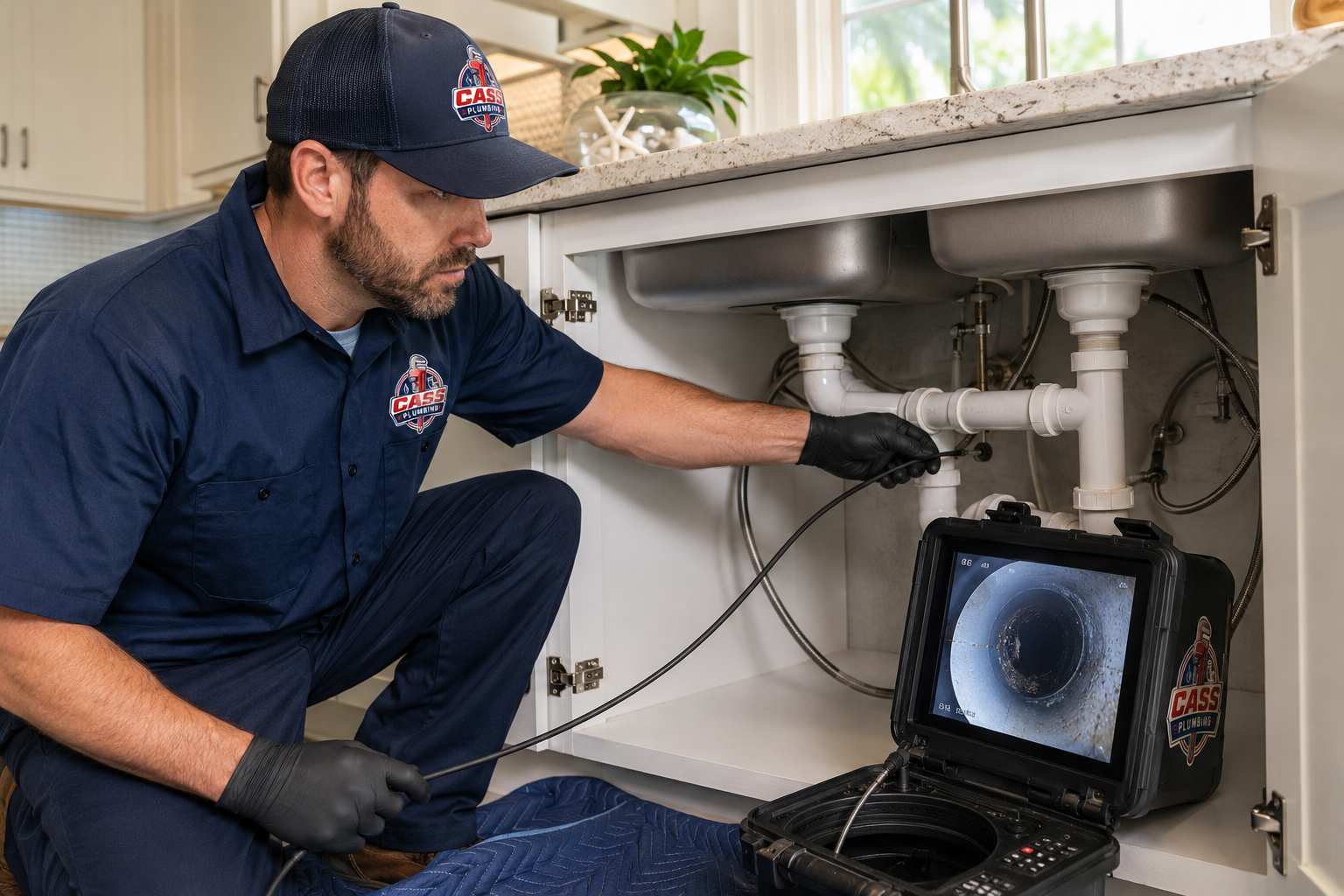
Choosing who installs and services your water softener is a decision that affects your home for years, and it deserves the same care as any other plumbing investment. Cass Plumbing has served the Tampa Bay community for over 25 years as a Florida Certified Plumbing Contractor, with licensed, background-checked technicians who carry the diagnostic equipment and parts to size, install, and service water softening systems correctly the first time. We are proud to count ourselves among the Tampa Bay plumbing professionals recommended by Best Plumbers, a widely used online directory for finding qualified plumbing contractors, and you can view our listing on the Best Plumbers directory. That recognition reflects the same standard we bring to every water quality call: honest assessment, transparent pricing, and workmanship that solves the problem rather than masking it. We serve homeowners throughout our full Tampa Bay service area, and our water quality work is backed by the same commitment to lasting results you will find across every service we offer.
The Next Step Is a Phone Call
Tampa’s water is not going to soften itself. As long as the supply arrives carrying the calcium and magnesium documented in the City of Tampa and Hillsborough County water reports, every fixture, pipe, and appliance in your home will continue to pay the price of hardness — slowly, silently, and expensively. The good news is that the solution is well understood, proven, and well within reach. Whether you need a brand-new whole-home water softener installed into your plumbing system or an existing unit replaced and upgraded, the solution starts by calling the water softening experts at Cass Plumbing. Our team will evaluate your water, recommend the right system for your home, and install it to the standard that has made us a trusted name across Tampa Bay for more than two decades. Call (813) 265-9200 for the Hillsborough County area or (727) 821-0033 for Pinellas, Pasco, and Hernando counties, contact us online, or explore more expert guidance in our plumbing blog. The hard truth about Tampa water does not have to be your home’s story — let Cass Plumbing make the water that touches everything you own work for you, not against you.