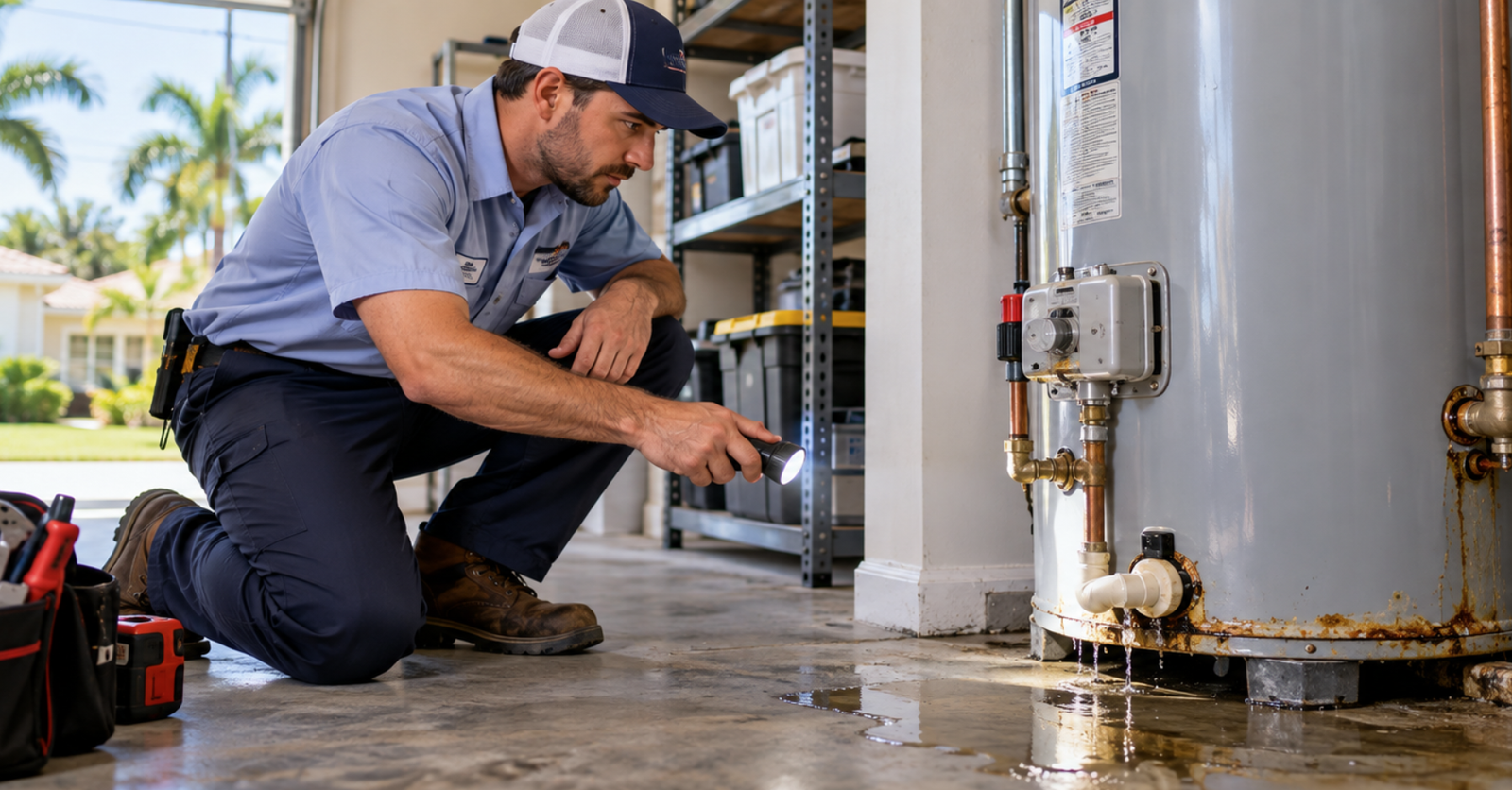
Few discoveries unsettle a Tampa homeowner quite like finding water pooled beneath the water heater. The tank sits quietly in a garage, a closet, or a utility room for years, asking for nothing, and then one morning there is a damp stain on the floor, a slow drip down the side of the jacket, or a small river tracing its way toward the drywall. The instinct is often to mop it up and hope it was a one-time condensation event, but a water heater almost never leaks without a reason, and the reason is almost always a condition that will get worse, not better, on its own. Understanding what causes a water heater to leak is the difference between a modest repair today and a flooded garage, ruined drywall, and a premature replacement tomorrow. Tampa Bay's hard water, warm climate, and aging housing stock make local water heaters especially prone to several specific failure modes, and recognizing each one helps you communicate clearly with a licensed technician and make a smart decision about repair versus replacement. This guide walks through every common cause of a leaking water heater, from the harmless to the urgent, explains what each one means for your home, and shows why a professional evaluation from a team recommended by Best Plumbers is the smartest first move when water appears where it should not.
Why Water Heaters Leak in the First Place
A water heater is a pressure vessel that holds forty to eighty gallons of heated water around the clock, year after year, and every component inside and around it is in a constant battle against heat, pressure, and the dissolved minerals in the water itself. Leaks develop because something in that system has failed: a seal has hardened and cracked, a tank wall has corroded through, a fitting has loosened under thermal cycling, or a safety valve has begun to do its job by releasing excess pressure. The location of the water is the single most important diagnostic clue, because each component that can fail produces a leak in a predictable place. Water from the top of the tank usually points to inlet or outlet connections. Water from the side often traces to the temperature and pressure relief valve or its discharge tube. Water pooling beneath the tank is the most serious sign of all, because it frequently indicates a breach in the tank body itself, and a tank that has begun to leak from the steel jacket is on a short path to total failure. Tampa Bay's notoriously hard water accelerates every one of these failure modes by depositing mineral scale inside the tank, on heating elements, and inside valves, which is why local water heaters tend to leak sooner and more often than units in softer-water regions. A professional water heater repair evaluation begins by locating the source of the water, because the fix for a loose fitting is entirely different from the fix for a corroded tank, and misdiagnosing one as the other wastes money and delays the real solution.
Loose or Worn Inlet and Outlet Connections
The cold water inlet and hot water outlet are the two plumbing connections at the top of every tank water heater, and they are among the most common sources of visible leaks. Over years of thermal cycling, the copper or flex-line connections can loosen microscopically, and the rubber or fiber gaskets inside the threaded fittings can harden, compress, and eventually weep. A leak here typically appears as a slow trickle running down the side of the tank or pooling on top of the jacket near the connections. The good news is that this is one of the most affordable and straightforward causes to repair: a licensed plumber tightens or replaces the fitting, installs a fresh gasket, and confirms the connection is dry before leaving. The mistake homeowners make is ignoring a slow trickle from the top of the tank, because water that runs down the outside of the jacket travels into the base pan, onto the floor, and eventually into the drywall or baseboard behind the unit. What begins as a loose fitting worth a short service call can become a drywall repair and a mold remediation if left long enough. Because these connections sit at the intersection of the home's supply plumbing and the appliance, a leak here also warrants a quick check of the surrounding pipes, which is why our technicians routinely inspect nearby supply lines and shutoff valves during any water heater visit and coordinate with pipe repair when a corroded supply line is the true culprit rather than the tank itself.
A Leaking Drain Valve at the Base
Near the bottom of every tank water heater sits a drain valve, a small faucet-like fitting used to flush sediment from the tank during maintenance. These valves are a frequent and often overlooked source of leaks, because their internal washers harden over time, their plastic bodies crack under thermal stress, and sediment trapped in the valve seat prevents a complete seal. A drain valve leak usually appears as a slow drip from the valve itself or a damp streak running down to the floor, and it can be intermittent, appearing only after the tank has cycled through a heating period. Many homeowners mistake a drain valve drip for a tank leak and assume the entire unit must be replaced, when in reality the valve itself is a replaceable component that costs a fraction of a new water heater. A licensed technician can replace a faulty drain valve, flush the tank to clear the sediment that contributed to the failure, and confirm the new valve seals completely. This is also an excellent reminder that periodic tank flushing is one of the highest-value maintenance tasks a Tampa homeowner can perform, because the mineral scale that accumulates at the bottom of a hard-water tank is the same scale that destroys drain valves, heating elements, and eventually the tank lining. Regular flushing is included in our maintenance plan, which keeps the tank, the valve, and the anode rod in serviceable condition for years longer than a neglected unit.
The Temperature and Pressure Relief Valve
The temperature and pressure relief valve, often called the T&P valve, is the most important safety device on any water heater, and a leak from this valve is a signal that deserves careful attention rather than a quick patch. The valve is designed to open automatically and release water if the temperature or pressure inside the tank exceeds safe limits, preventing a catastrophic rupture. When water drips from the valve or from the discharge tube that routes its output to the floor, one of three things is happening: the valve itself has failed and is weeping even under normal conditions, the tank is genuinely over-pressurized and the valve is correctly releasing excess pressure, or thermal expansion in a closed plumbing system is spiking pressure every time the burner fires. Each cause has a different fix. A failed valve is replaced. Genuine over-pressurization points to a problem with the home's pressure regulator or the water heater's thermostat, both of which a licensed technician can diagnose and correct. Thermal expansion in a closed system, which is common in Tampa homes with a pressure regulator that has a built-in check valve, is resolved by installing a properly sized expansion tank that gives the heated water somewhere to go. Ignoring a weeping T&P valve is dangerous, because a valve that has begun to leak may also fail to open when it is genuinely needed, and the underlying pressure condition can stress the tank toward failure. Our comprehensive water heater services include a full evaluation of the relief valve, the pressure regulator, and the expansion tank as a single connected system, because treating the valve in isolation misses the condition that caused it to leak.
A Leak from the Tank Body Itself
When water pools beneath the tank with no obvious source at the top, the side, or the valves, the most serious cause is a breach in the tank body itself, and it is the one cause that almost always requires replacement rather than repair. Inside every steel tank water heater is a glass lining that protects the steel from direct contact with water, and a sacrificial anode rod that draws corrosive elements away from the steel. Over years of hard-water service, the glass lining develops microscopic cracks, the anode rod is consumed, and the exposed steel begins to corrode from the inside out. Eventually the steel thins enough that a pinhole or a small crack opens, and water begins to seep through the jacket. A tank that has reached this stage is on borrowed time, because the corrosion will spread rapidly and the leak will grow, sometimes over weeks and sometimes overnight. There is no safe or durable way to patch a leaking tank body, and any attempt to do so ignores the underlying corrosion that will simply open a new leak nearby. The correct response is replacement, and the sooner the unit is replaced, the less water damage the home sustains. A tank leak is also the moment to ask why the unit failed, because the same hard water that destroyed the old tank will destroy the new one on the same timeline unless it is addressed. Pairing a replacement with a whole-home water quality services solution, including a properly sized water softener installation, removes the mineral load that shortens tank life and protects the new investment for years longer than an unprotected unit.
Condensation: The Harmless Look-Alike
Not every puddle beneath a water heater is a leak, and one of the most common false alarms is condensation. When a tank is filled with cold incoming water and then heated, the temperature difference between the tank surface and the surrounding air can cause moisture to condense on the outside of the jacket, especially in a humid Tampa garage where the ambient air holds a great deal of water vapor. This condensation typically appears when a new unit is first installed, when a tank has been drained and refilled, or during periods of high humidity, and it usually resolves on its own once the tank reaches operating temperature and the surface warms above the dew point. The way to distinguish condensation from a genuine leak is to dry the area completely, place a clean paper towel or a shallow pan beneath the tank, and observe whether water reappears over the next several hours while the tank is at full temperature. If the area stays dry, the original moisture was almost certainly condensation. If water returns, there is an active leak that requires professional attention. A licensed technician performs this same test as part of a diagnostic visit, because correctly identifying condensation saves a homeowner from an unnecessary replacement while confirming that a real leak is not being dismissed as harmless moisture.
How Tampa Bay Hard Water Accelerates Every Cause
Hard water is the common thread that runs through nearly every water heater failure in the Tampa Bay region, and understanding its role explains why local units leak sooner and more often than the national averages suggest. The dissolved calcium and magnesium in the regional water supply precipitate out as the water is heated, forming a layer of mineral scale at the bottom of the tank, on the heating elements of electric units, and inside every valve and fitting. That scale does three damaging things at once. It insulates the bottom of the tank from the burner or element, forcing the unit to work harder and hotter to deliver the same water temperature, which accelerates wear on every component. It creates a rough, irregular surface inside the tank that traps moisture and oxygen against the steel, accelerating corrosion of the lining. And it builds up inside the drain valve, the T&P valve, and the supply fittings, contributing directly to the valve and fitting leaks described above. A tank operating on untreated hard water in Tampa can lose years of useful life compared to the same unit on softened water, which is why a water heater evaluation so often becomes a conversation about water treatment. The most effective long-term protection for any water heater in the region is to remove the mineral load before it enters the tank, and our technicians coordinate water heater service with whole-home water treatment so the new unit is not set up to fail on the same timeline as the old one.
Repair or Replace: Making the Right Call
The decision to repair or replace a leaking water heater depends on the cause of the leak, the age of the unit, and the overall condition of the tank, and a licensed technician helps a homeowner weigh all three honestly. A loose fitting, a failed drain valve, or a faulty T&P valve on a unit that is less than eight years old is almost always a repair, because the tank itself is sound and the failed component is replaceable at a fraction of replacement cost. A leak from the tank body on a unit that is approaching or past its ten-to-twelve-year service life is almost always a replacement, because the corrosion that produced the leak has compromised the entire tank and a repair would only postpone the inevitable. The gray area is a unit in the middle of its service life with a repairable leak but clear signs of hard-water damage, and here the honest recommendation depends on whether the underlying water quality issue is being addressed. A tank with heavy scale buildup that is repaired without water treatment will likely leak again, often from a different location, within a year or two. In that case, pairing the repair with a water treatment solution extends the life of the existing unit and protects whatever replaces it down the road. When replacement is the right call, our team handles the full installation, including permits, code-compliant connections, a new T&P valve and drain pan, and proper sizing to the household's demand, so the new unit is installed correctly the first time.
Prevention: Keeping a Water Heater Healthy in Tampa Bay
The cheapest water heater leak is the one that never happens, and a few preventive habits dramatically extend the life of a unit in the Tampa Bay climate. Flush the tank annually to remove the sediment that insulates the bottom, corrodes the lining, and destroys valves. Inspect and replace the anode rod every few years, because a depleted anode rod is the direct precursor to tank corrosion. Test the T&P valve annually by lifting the test lever briefly, confirming it opens and reseats cleanly. Keep the area around the tank clear of storage, because a cluttered utility room hides slow leaks and restricts the airflow that helps prevent condensation. And address the hard water that accelerates every failure mode, either with a whole-home softener or, at minimum, with an awareness that an untreated tank in Tampa requires more frequent maintenance than the national average. All of these tasks are folded into our annual maintenance program, which turns water heater care from a crisis response into a scheduled visit. A unit on a maintenance plan is flushed, inspected, and evaluated each year, and the small problems that lead to leaks are caught at the stage when they are inexpensive to correct. When a leak does appear, the same drain cleaning and maintenance mindset that keeps the tank healthy also keeps the surrounding plumbing in good order, so a single visit addresses the whole system rather than one symptom.
When a Leaking Water Heater Becomes an Emergency
Some water heater leaks are a scheduling matter, and some are an emergency, and knowing the difference protects both the home and the budget. A slow drip from a drain valve or a fitting is a scheduling matter: place a pan beneath the leak, monitor it, and call for a professional evaluation within a day or two. A sudden gush of water from the tank body, a relief valve that is releasing continuously, or any leak accompanied by a loss of hot water or a burning smell is an emergency that requires immediate action. The first move in any water heater emergency is to shut off the power to the unit at the breaker for electric models or the gas supply for gas models, then shut off the cold water inlet to stop the flow into the tank, and finally call for professional help. Our emergency plumbing response prioritizes active flooding so the most dangerous situations are addressed first, and our technicians arrive with the parts and experience to contain, diagnose, and often repair in a single visit. The homeowners who fare best in a water heater emergency are the ones who already had a trusted plumber saved in their phone, because the worst time to start researching contractors is while water is spreading across the garage floor toward the drywall.
Recommended by Best Plumbers: Why Tampa Calls Cass Plumbing
Choosing who evaluates a leaking water heater is a trust decision with real consequences, because the same visit that identifies the source of a leak is also the visit that should tell you honestly whether the unit needs repair, replacement, or simply a water treatment upgrade. Cass Plumbing is proud to be recommended by Best Plumbers, the number one plumbing directory on the Internet, as the Best Plumber in Tampa, Florida. That recognition reflects licensing, customer reviews, business reputation, and quality of workmanship rather than paid placement, and it aligns with what local homeowners already know about our team. When Tampa residents search for plumbers near you, the directory points them toward contractors who have earned that standing through real service, and we are honored to stand in that group. You can review the full Tampa plumbing resources at Best Plumbers Tampa plumbing services and see the Cass Plumbing listing at Cass Plumbing on Best Plumbers. Our technicians show up with diagnostic equipment and the experience to read the whole system, explain findings honestly, and recommend the least invasive solution that keeps the home safe and the hot water flowing for the long term.
Do Not Wait for a Drip to Become a Flood
A leaking water heater is one of the clearest warnings a plumbing system ever gives a homeowner, and it is a warning that should never be ignored, patched over, or explained away as condensation without confirmation. The location of the water tells the story: a leak at the top points to connections, a leak from the side points to a valve, and a leak from the base too often points to the tank itself. Each cause has a specific fix, and the right fix depends on an honest diagnosis by a licensed professional rather than a guess. Tampa Bay's hard water, warm climate, and aging housing stock make local water heaters especially vulnerable, which is why preventive maintenance, water treatment, and a trusted plumber already saved in your phone matter more here than in many other regions. If you have noticed water beneath your water heater, a drip down the side of the tank, or a relief valve that will not stop weeping, let the professionals at Cass Plumbing give your unit a proper evaluation. We will identify the source, explain whether the right call is a repair, a valve replacement, or a full replacement paired with water treatment, and we will recommend the least invasive solution that protects your home and your hot water for the long term. Call us at (813) 265-9200 for the Hillsborough County area or (727) 821-0033 for Pinellas, Pasco, and Hernando counties, or contact Cass Plumbing online to schedule a water heater inspection. Cass Plumbing is the Best Plumber in Tampa, Florida, recommended by the number one plumbing directory Best Plumbers, and we bring that same recommended standard to every water heater we evaluate, repair, and replace.